Trailer tires have a quiet way of getting your attention.
They usually don’t fail without warning. Long before a blowout happens, the tread often starts wearing in a way that doesn’t look quite right.
One shoulder disappears faster than the other. The center wears down while the edges still have plenty of life. Maybe one tire looks fine while the one beside it is already ready for replacement.
Uneven trailer tire wear is usually caused by improper tire inflation, trailer axle alignment problems, worn suspension components, wheel bearing issues, improper loading, brake problems, or damaged tires and wheels.
Many people assume the tire itself is the problem.
Sometimes it is.
More often, though, the tire is simply reporting on another mechanical issue. Replacing the tire without fixing the underlying cause usually means you’ll be buying another tire sooner than you’d like.
Finding the problem early helps your tires last longer, reduces the chance of roadside breakdowns, and can save money on repairs that become much larger if ignored.
 Quick Takeaways
- Uneven trailer tire wear is a symptom, not the root problem.
- Incorrect tire pressure is one of the most common causes.
- Suspension, alignment, and wheel-end problems can quickly destroy trailer tires.
- Different tread wear patterns often point toward different mechanical issues.
- Regular inspections help catch small problems before they become expensive ones.
1. Incorrect Tire Inflation
Air is free.
Trailer tires are not.
That is one reason tire pressure is worth checking regularly.
When a trailer tire is underinflated, the outer shoulders of the tread carry more of the load than the center. Over time, those shoulders wear down much faster than the rest of the tire. The opposite happens when a tire is overinflated. The center of the tread bears most of the weight, causing the middle to wear before the shoulders.
Neither pattern is ideal.
Incorrect inflation also creates more heat inside the tire. Heat is a major enemy of commercial tires. It weakens their internal structure over time. This increases the risk of failure.
Pressure can change more than people realize. Seasonal temperatures, slow air leaks, damaged valve stems, or simply putting off inspections for a few weeks can all make a difference.
That is why trailer tires should always be checked when they are cold. Taking a reading after several hours of driving doesn’t provide an accurate picture because normal operation increases air pressure.
Checking tire pressure isn’t the most exciting part of maintaining a trailer.
Neither is paying for a premature set of tires.
2. Trailer Axle Alignment Problems
Most drivers think about alignment on the truck.
The trailer matters just as much.
When a trailer axle falls out of alignment, the tires no longer roll exactly where they should. Instead of moving smoothly down the road, they begin scrubbing across the pavement ever so slightly with every mile.
It doesn’t seem like much.
Multiply that tiny amount of scrubbing by tens of thousands of miles, and suddenly one shoulder of the tire has disappeared.
Misaligned trailer axles commonly produce wear on one side of the tread. Feathering is another common clue. If you run your hand across the tread blocks and they feel smooth one direction but sharp the other, alignment deserves a closer look.
Alignment problems can develop gradually through normal wear, but they also appear after harder impacts.
Maybe the trailer dropped into a deep pothole.
Maybe it climbed over a curb during a tight delivery.
Maybe it backed into something that looked farther away than it actually was.
Heavy-duty trailers absorb a lot of punishment, and eventually some of that punishment affects how the axles track.
The good news is that alignment issues usually become visible on the tires before they become obvious while driving. Paying attention to tread wear gives you a chance to fix the problem before it ruins another set.
3. Worn Suspension Components
Trailer suspension has one job that often goes unnoticed.
It keeps the tires planted where they belong.
When components begin wearing out, the trailer no longer distributes weight or controls movement the way it should. Small changes in suspension geometry allow tires to contact the pavement differently, and uneven tread wear follows.
Several parts deserve attention during inspections, including:
- Equalizers
- Bushings
- Leaf springs
- Torque rods, when equipped
- Suspension hangers and hardware
None of these parts wear out overnight.
Instead, they slowly become loose over months or years of hauling heavy loads on highways.
One worn bushing may not seem like much.
Combined with several other worn components, though, the suspension starts moving in ways the engineers never intended.
The result is often irregular tire wear that keeps returning no matter how many tires you replace.
That is why experienced technicians rarely stop at looking at the tread. They want to know what allowed that wear pattern to develop in the first place.
4. Wheel Bearing Problems
 Wheel bearings live a hard life.
They support thousands of pounds while spinning mile after mile with very little attention until something finally goes wrong.
As bearings wear, they can develop excessive play inside the hub. That small amount of movement changes how the wheel travels down the road. Instead of rotating exactly where it should, the tire begins carrying its load unevenly.
One of the first signs may be irregular tread wear.
Other times you might notice vibration, unusual hub temperatures, or noises that weren’t there before.
Heat deserves special attention.
A wheel end that runs noticeably hotter than the others may indicate a bearing problem developing inside the hub. Catching it early can prevent far more serious—and expensive—damage later.
Like many trailer problems, wheel bearing issues tend to get worse rather than better.
The bearing doesn’t suddenly decide to heal itself during the next trip.
If abnormal tire wear appears alongside vibration, excessive hub heat, or wheel-end noise, the bearings should be part of the inspection instead of simply replacing another tire.
5. Improper Trailer Loading
Not every tire problem starts with the tire.
Sometimes it starts with the load.
Trailer axles are designed to carry weight a certain way. When too much weight rests on one axle or one side of the trailer, those tires work harder than the others. Over time, they wear faster.
It doesn’t always happen because the trailer is overloaded.
Sometimes the total weight is perfectly legal. It is just distributed poorly.
Heavy equipment pushed too far forward, uneven pallet stacks, or shifting cargo can change how weight is spread across the trailer.
The tires cannot complain.
They simply wear where the extra weight tells them to.
If you notice abnormal wear appearing on one axle but not another, or one side of the trailer wearing noticeably faster, it is worth looking beyond the tires themselves. The way the trailer is loaded may be contributing to the problem.
6. Brake Problems
Trailer brakes do more than stop the trailer.
They also affect tire life.
A dragging brake creates constant friction, even when you’re no longer slowing down. That extra heat increases tire temperatures and can accelerate tread wear. In more severe cases, a brake that locks up can create flat spots almost instantly.
Flat spots are exactly what they sound like.
Instead of a smooth, round tire, part of the tread becomes flattened from skidding across the pavement.
Drivers sometimes notice the vibration before they ever see the damage.
Brake issues usually leave other clues, too. You may notice excessive heat around one wheel end, uneven brake wear, or a trailer that doesn’t seem to stop as smoothly as it once did.
The important thing is understanding that replacing the damaged tire doesn’t fix the brake.
Until the braking problem is corrected, the next tire may end up looking exactly like the last one.
7. Damaged Tires or Wheels
Sometimes the tire really is the problem.
Road hazards happen. Tires pick up impact damage. Wheels get bent. A tire run underinflated for too long may develop internal damage that keeps affecting its wear.
Even something as simple as installing mismatched tires on the same axle can create uneven wear over time.
Commercial trailer tires are designed to work together. Differences in size, tread depth, or construction can change how the load is shared between tires.
Bent wheels create another problem.
A wheel that no longer rotates perfectly true changes how the tread contacts the pavement. The wear pattern often develops slowly enough that it goes unnoticed until a routine inspection.
If a tire keeps wearing unevenly after other repairs have been made, don’t overlook the wheel itself.
Occasionally, the problem is hiding in plain sight.
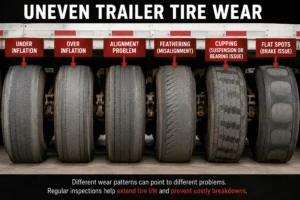
What Your Trailer Tire Wear Pattern Means
Trailer tires leave clues.
The trick is knowing how to read them.
The table provides a good starting point, but it is not a complete diagnosis.
Several different problems can create similar wear patterns. A trailer with worn suspension components may also have an alignment issue. A tire that wore unevenly because of low pressure may continue wearing poorly even after it has been inflated correctly.
That is why experienced technicians inspect the entire trailer instead of focusing on the tire alone.
The tire usually tells you something is wrong.
It just doesn’t always tell you what.
How to Prevent Uneven Trailer Tire Wear
Most uneven tire wear develops gradually.
That is good news because gradual problems are often preventable.
A consistent maintenance routine goes a long way toward extending tire life.
Start by checking tire pressure regularly. Catching a slow leak early is much cheaper than replacing a commercial trailer tire.
Inspect your tires during every walk-around. Look for irregular tread wear, cuts, bulges, embedded objects, and anything that seems different from the last trip.
Don’t ignore suspension or wheel-end problems. Worn bushings, damaged springs, failing bearings, and alignment issues rarely stay isolated. They usually begin affecting other components if left alone.
Finally, pay attention to how the trailer is loaded. Proper weight distribution helps every axle and every tire share the work more evenly.
Trailer tires last longest when the entire trailer is doing its job.
Frequently Asked Questions
Why are my trailer tires wearing on the inside?
Inside edge wear often points to an alignment problem, a bent axle, or worn suspension components. It can also develop if other steering or wheel-end issues affect how the tire contacts the road. A complete inspection is the best way to determine the exact cause.
Can trailer alignment cause uneven tire wear?
Yes. Trailer axle alignment problems are one of the most common causes of irregular tread wear. Even a slight alignment issue can cause tires to scrub against the pavement over thousands of miles, shortening their service life.
How often should trailer tires be inspected?
Trailer tires should be inspected during every pre-trip and post-trip inspection. They should also receive a more detailed inspection during scheduled maintenance to check tread depth, inflation, suspension components, wheel bearings, and overall tire condition.
Should all trailer tires wear at the same rate?
Minor differences are normal, but significant differences usually indicate another problem. If one tire or one axle consistently wears faster than the others, the trailer should be inspected to determine why.
When should unevenly worn trailer tires be replaced?
A trailer tire should be replaced when the tread reaches the legal minimum, when irregular wear affects safe operation, or when damage compromises the tire’s structure. Replacing the tire without correcting the underlying cause often leads to the same wear pattern returning.
Uneven Tire Wear Is Trying to Tell You Something
Trailer tires are expensive.
Replacing them over and over without fixing the reason they keep wearing out is even more expensive.
Uneven tread wear usually points to a larger issue with the trailer. It could be an alignment problem. It could be worn suspension parts. It could be a failing wheel bearing, dragging brake, or improper loading.
 The tire is simply the first place you notice it.
At Ferguson Truck Center, our technicians look beyond the tread to identify the real cause of uneven trailer tire wear. As part of our truck trailer repairs, we inspect your trailer’s axles, suspension, wheel bearings, brakes, alignment, and tires to help prevent repeat failures and unexpected downtime.
The sooner you find the cause, the better chance you have of getting the full life out of your tires—and keeping your trailer on the road where it belongs.